

Sala bistro Sanur has quietly redefined what a coastal Bali dining space can feel and look like. Its Nordic-meets-tropical aesthetic, anchored by terracotta tones, natural wooden furnishings, and a breezy open-air layout, is exactly the kind of spatial storytelling that homeowners and villa owners across Bali are now eager to replicate in their own living environments.
Key Highlights
- Sala bistro Sanur blends Nordic minimalism with Balinese warmth, using terracotta, exposed brick, rattan, and teak as its core material vocabulary.
- Tropical bistro-style interiors are one of the strongest home design movements of late 2026, with nature-immersive living driving client briefs across Bali villa projects.
- Three materials dominate this look: reclaimed teak, natural rattan, and limewashed plaster walls, all of which are both sustainable and built for Bali’s demanding climate.
Why the Sala Bistro Sanur Aesthetic Is Converting Homeowners in 2026
Sala bistro Sanur is a Nordic-inspired restaurant located on Jl. Danau Tamblingan, offering a clean, minimalist atmosphere designed by Blanco Studio. Since opening, it has become a favorite Sanur dining spot known for its bright, modern interiors, soft neutral color palette, and warm, welcoming ambiance.
Our design team has been asked consistently over the past year to translate this precise spatial feeling into private Bali villas and homes. The interior blends terracotta tones and exposed brick with Nordic-inspired furniture and natural light, creating a space that feels both inviting and stylish.
In 2026, interiors are moving toward nature-immersive living. Balinese style embraces organic materials, warm neutral tones, and seamless indoor-outdoor harmony, creating spaces that feel breathable, grounded, and emotionally soothing.
The Sala Bistro Sanur Material Blueprint
Once you enter the indoor area, you will find some spots to sit with a minimalist design and the touch of tropical vibe from the wooden and rattan. This is the precise combination that makes the sala bistro sanur interior feel simultaneously calm and characterful. Together, teak and rattan create a material pairing that belongs to the tradition of tropical modernism: functional, honest, and warm without being decorative.
If you are styling a living room or villa dining space with this aesthetic, you need to understand exactly which materials perform best and why.
Material Comparison Table: Rattan vs. Teak for Bali Interiors
| Property | Natural Rattan | Reclaimed Teak |
|---|---|---|
| Sustainability Rating | Very High (FSC-certified) | High (FSC Grade A recommended) |
| Maturity/Regrowth Rate | 5 to 7 years | 25 to 50 years |
| Climate Suitability (Bali) | Excellent (indoor/covered) | Exceptional (indoor + outdoor) |
| VOC Emissions | Zero (unfinished) | Near-zero (natural oil finish) |
| Aesthetic Style | Airy, bohemian-tropical, casual | Rich, formal, classic Balinese |
| Best Application | Accent chairs, pendants, screens | Dining tables, structural elements, bed frames |
| Maintenance Frequency | Bi-annual oiling/lacquering | Annual teak oil application |
| Average Cost per Piece (Bali) | IDR 800K to IDR 3.5M | IDR 2.5M to IDR 15M+ |
| Market Growth (2026-2030) | 5.8% CAGR | 5.4 to 6.3% CAGR |
| Interior Bali Recommendation | High for casual tropical look | High for long-term investment |
Rattan regenerates quickly, typically reaching maturity within 5 to 7 years, making it more sustainable than many hardwoods. In 2026, the demand for natural materials and sustainable furniture continues to grow, making rattan one of the most sought-after choices for both residential and hospitality interiors.
Reclaimed teak is far more than just a rustic aesthetic choice; it is a vital engineering decision for tropical climates. According to market data from Coherent Market Insights, the indoor teak furniture segment is projected to capture 73.4% of the global teak furniture market in 2026, driven by strong demand for durable and elegant interior furnishings.
Translating Sala Bistro Sanur Into Your Home or Villa
Surrounded by modern and minimalist Scandinavian décor with the neutral hue, sala bistro sanur gives this area a refreshing facelift in a cozy and fun ambiance. Our experience with Bali villa transformations suggests the most effective method is to work in three distinct styling layers: the base palette, the material layer, and the organic accent layer.
With limewashed whites and natural beiges in conversation with reddish clay tones, the space has a clean, architectural confidence that is easy to photograph and even easier to stay in for hours. This is a formula any homeowner can apply.
The Sala Bistro Sanur Three-Layer Styling System
| Layer | What It Is | Materials to Use | Where to Apply It |
|---|---|---|---|
| Base Palette | The foundational wall, ceiling, and floor tone | Limewash white, coconut white, warm sand | Walls, ceilings, terrazzo flooring |
| Structural Warmth | Anchoring furniture and built elements | Reclaimed teak, clay brick, exposed concrete | Tables, bar counters, bench seating |
| Terracotta Accent | The warmth layer that stops a space from feeling cold | Terracotta brick, clay pottery, fired tile | Feature walls, pot clusters, bar island |
| Rattan Softness | Texture and tropical lightness | Natural rattan chairs, pendants, cane screens | Dining seats, lighting, partition walls |
| Living Green Layer | Biophilic element that completes the tropical feel | Tropical foliage, hanging plants, vertical gardens | Canopy above dining area, entry corners |
| Nordic Edit | The restraint that keeps the space from feeling cluttered | Minimal shelving, clean-line cabinetry | Kitchen, bar display, bookshelves |
The global generic look is a trend of the past; guests want to experience the essence of a place, and interior design is key in creating such bespoke experiences. We craft narratives, infusing local culture, craftsmanship, indigenous materials, and patterns to echo the identity of a destination. This is the precise philosophy behind sala bistro sanur’s remarkable spatial power.
Color Palette Guide: From Sala Bistro Sanur to Your Living Space
The earthy and natural tones inspired by Bali create a warm and inviting atmosphere in any space. You can incorporate shades of brown, beige, terracotta, and deep greens to reflect the rich landscapes and materials found on the island.
The designers ground the color palette in neutral tones to create a calm backdrop, while they add depth and vibrancy through warm earthy accents like terracotta, greens, and browns.
According to the Pantone Color Institute’s 2026 Tropical Living Report as identified by our colleagues at Interior Bali, warm terracotta, soft sage, warm sand, and deep espresso brown are the defining tones of Southeast Asian hospitality interiors this year.
H3: Sala Bistro Sanur Inspired Color Palette for Homes and Villas
| Color Name | Hex Code | Best Application | Pairs With | Mood Effect |
|---|---|---|---|---|
| Limewash White | #F7F3EC | Base walls, ceilings | All natural materials | Airy, expansive |
| Warm Terracotta | #C2714F | Feature walls, clay pots, brick accents | Rattan, raw linen | Grounded, earthy |
| Coconut Sand | #E8DBC5 | Floor plaster, secondary walls | Teak, cane | Warm, serene |
| Espresso Brown | #3E2723 | Teak furniture, structural beams | White and terracotta | Anchored, rich |
| Soft Sage Green | #9CAF88 | Cushions, tropical plant clusters | All neutrals | Refreshing, biophilic |
| Nordic Stone Grey | #B2AFA8 | Bar counter, concrete accents | Limewash white, teak | Clean, modern |
| Fired Clay Red | #A0522D | Exposed brick, tile details | All base tones | Warm, Balinese |
Dining Space Styling: What Sala Bistro Sanur Does Right
One of the most common approaches seen in Bali boutique restaurants is the use of natural materials in tableware and tabletop decor. These natural materials resonate with the island’s tropical surroundings and often make dining spaces feel more relaxed yet thoughtfully designed.
Small decorative elements are often used strategically in Bali boutique restaurants to add personality to the dining table. A small vase with a single bloom, a candle, or a handcrafted napkin ring can create focal points without cluttering the space.
Our design team noted that the genius of sala bistro sanur’s dining zone lies in this editorial restraint. It is not about adding more; it is about selecting better materials with intentional placement.
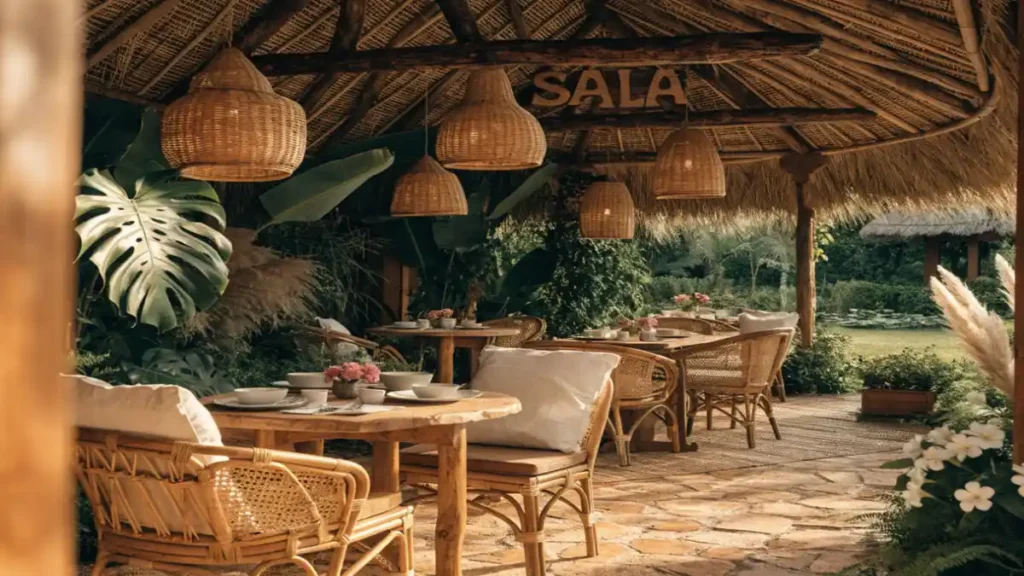
Dining Room Styling Checklist Inspired by Sala Bistro Sanur
| Element | Material/Style | Budget Range (IDR) | Priority Level | Notes |
|---|---|---|---|---|
| Dining Table | Solid reclaimed teak, raw finish | 4.5M to 12M | Essential | Grade A teak with natural oil treatment |
| Dining Chairs | Natural rattan with leather or linen seat pad | 850K to 2.5M per chair | Essential | Mix 4 rattan + 2 teak bench seating |
| Pendant Lighting | Woven bamboo or rattan dome pendants | 600K to 2M per pendant | High | Cluster 3 over long table |
| Table Surface Styling | Ceramic plates, linen napkins, clay candle holders | 200K to 800K per setting | Medium | Avoid plastics entirely |
| Wall Feature | Limewash plaster or exposed clay brick accent wall | 2M to 8M per wall | High | One feature wall behind head of table |
| Greenery | Hanging pothos, single palm, monstera pot | 150K to 500K per plant | High | Minimum 3 plants in dining zone |
| Floor Material | Terrazzo or polished concrete | 400K to 900K per m² | Medium | Link indoor to outdoor seamlessly |
| Textiles | Batik runners, raw linen cushion covers | 350K to 1.2M | Accent | Add cultural grounding to neutral palette |
Sustainable Material Standards: What Our Studio Upholds
One of the biggest mistakes homeowners make is importing design concepts from Europe or Australia without adapting them to Bali’s environment. High humidity, salt air in coastal areas, and intense sunlight can destroy unsuitable materials in months.
Professional interior design in Bali is not just about choosing colors; it is about choosing materials that survive. For instance, using Grade A teak wood (specifically treated for termites) and moisture-resistant fabrics is non-negotiable for longevity.
We recommend referencing FSC International and INBAR (International Bamboo and Rattan Organisation) when sourcing natural materials for Bali projects. Sustainable rattan harvesting can incentivize forest protection by providing an economic alternative to deforestation. INBAR’s 2026 Trade and Sustainability Forecast identified a 23% year-on-year increase in natural rattan furniture imports into the EU alone.
Rising consumer demand for sustainability, with 78% finding a sustainable lifestyle important and 76% willing to pay a premium, combined with teak supply constraints, is accelerating adoption of FSC-certified hardwoods, bamboo, and recycled materials.
Eco-Friendly Material Statistics for Bali Interior Projects (2026)
| Material | Regrowth/Replenishment Rate | Carbon Status | FSC Certification Available? | Humidity Resistance | Interior Bali Grade |
|---|---|---|---|---|---|
| Natural Rattan | 5 to 7 years | Carbon-sequestering | Yes | Good (covered indoor) | A+ (Sustainable Pick) |
| Reclaimed Teak | Pre-harvested/repurposed | Net-zero (reclaimed) | Yes (Grade A) | Exceptional | A+ (Premium Pick) |
| Bamboo | 3 to 5 years | Carbon-negative | Yes | Moderate (treat for moisture) | A (Structural/Feature) |
| Volcanic Stone (Paras) | Non-renewable (locally quarried) | Low impact (local source) | N/A | Excellent | A (Flooring/Walls) |
| Reclaimed Brick/Terracotta | Repurposed/fired local clay | Low impact | N/A | Good | A (Accent walls) |
| Synthetic Rattan (HDPE) | Non-renewable | High embodied carbon | No | Excellent | C (Avoid indoors) |
| Imported Hardwood (untreated) | 50 to 100+ years | High carbon cost | Often no | Poor without treatment | D (Not recommended) |
Room-by-Room Villa Transformation Guide
In 2026, Balinese interior design characteristics are being blended with minimalism, a trend known as Bali-Minimal. The idea is to keep the Balinese soul but strip away the clutter. This is exactly what sala bistro sanur achieves with its interior, and what we aim to bring into every villa and home project we take on.
We often incorporate natural materials like bamboo, teakwood, and volcanic stone, blending them seamlessly with contemporary finishes, creating spaces that feel grounded yet refined, perfectly suited for today’s mindful traveler and local patron alike.
Room-by-Room Styling Matrix
| Room | Key Sala-Inspired Element | Priority Material | Lighting Style | Green Element | Estimated Reno Cost (IDR) |
|---|---|---|---|---|---|
| Living Room | Open-air flow, low teak seating, rattan accents | Reclaimed teak sofa frame | Rattan dome pendants + floor lamp | Monstera, palm, pothos shelf | 25M to 65M |
| Dining Room | Long teak communal table, rattan chairs, clay brick wall | Teak + rattan combination | Cluster pendants above table | Hanging plants, single stem vases | 20M to 50M |
| Master Bedroom | Low-profile teak bed, linen textiles, neutral palette | Solid teak bed frame | Warm ambient + rattan bedside lamp | Potted tropical fern | 30M to 80M |
| Kitchen | Open shelving, teak cabinetry, terrazzo counter | Teak cabinetry + stone island | Under-cabinet warm strip, pendant | Herb vertical wall garden | 40M to 120M |
| Bathroom | Open-sky concept, volcanic stone, teak vanity | Paras volcanic stone, teak | Warm recessed lighting | Tropical fern, bamboo planter | 20M to 60M |
| Outdoor Terrace | Alang-alang canopy, terracotta floor, rattan lounge | Natural rattan + bamboo | Solar lanterns, string lights | Climbing plants, frangipani | 15M to 45M |
| Villa Entry | Carved teak gate, frangipani offering stone, water feature | Teak + volcanic stone | Uplighting on foliage | Balinese garden, water lily | 10M to 30M |
A living room that opens straight onto the pool terrace is the hallmark of a great tropical home. Wide bi-fold glass doors, continuous terrazzo flooring from kitchen to patio, and indoor planters blur the threshold.
It is also important to respect the concept of Tri Hita Karana, the Balinese philosophy of harmony between humans, nature, and the divine. Every great Bali interior we design is rooted in this framework.
When to Hire a Professional Design Studio for Your Sala-Inspired Project
If you are styling this living space for personal use or short-term villa rental, some elements can be self-managed. However, our experience with Bali villa transformations suggests that full-scale projects benefit enormously from professional guidance. Here is a clear framework for making that decision:
- Hire a studio when your project involves structural changes such as adding bi-fold doors, an open terrace, a pool pavilion, or a new kitchen layout.
- Hire a studio when you need custom teak joinery or handcrafted built-in furniture to fit non-standard villa dimensions.
- Self-style when you are updating soft furnishings, lighting, greenery, and tabletop decor within an already functional space.
- Hire a studio when you are preparing a villa for rental listing and need to meet international guest expectations for authentic Bali design.
- Self-style when working on a single room refresh using our styling checklists above.
- Hire a studio when your project requires FSC-certified material procurement, moisture engineering, or passive cooling design for a new build.
Technology in 2026 is invisible. Smart home systems are now integrated into the very fabric of modern Bali interior design, allowing for automated climate control that mimics natural breezes and lighting that shifts its color temperature based on the time of day.
Maintenance Timeline for Natural Materials in a Bali Climate
Unlike alternative materials such as aluminum, synthetic rattan, or softwood, teak requires no painting, sealing, or chemical treatment to maintain its structural integrity, and it naturally weathers to an attractive silver-grey patina over time if left untreated.
Traditional Balinese interlocking joinery allows the dense tropical wood to shift with the wet and dry seasons without cracking, ensuring your investment lasts for decades.
Tropical Material Maintenance Schedule for Bali Homes and Villas
| Material | Wet Season Care | Dry Season Care | Annual Task | Lifespan (Bali Climate) | Cost of Upkeep/Year (IDR) |
|---|---|---|---|---|---|
| Solid Teak (Grade A) | Wipe dry, check for moisture pooling | Apply teak oil | Inspect joints, re-oil if faded | 30 to 70 years | 200K to 500K |
| Natural Rattan | Move indoors or under cover | Light lacquer spray if fading | Deep clean + lacquer | 7 to 15 years | 100K to 300K |
| Bamboo (structural) | Check for moisture ingress | Apply anti-mould sealer | Full sealer coat | 10 to 20 years | 150K to 400K |
| Volcanic Stone (Paras) | Rinse after heavy rain | Clean with soft brush | Seal porous areas | 50+ years | 50K to 150K |
| Terracotta Tile | Check grout lines | Re-seal if absorption visible | Grout renewal | 20 to 40 years | 100K to 250K |
| Limewash Plaster Walls | Monitor for salt bloom in coastal areas | Light touch-up painting | Full wall inspection | 5 to 10 years per coat | 300K to 1M |
| Rattan Pendants (lighting) | Keep away from direct rain | Dust with dry cloth | Replace wiring inspection | 5 to 10 years | 50K to 200K |
The Sala Bistro Sanur Design Legacy and What It Means for Your Home
Sala bistro Sanur is rated 4.8 out of 5 based on 1,762 reviews by visitors. That level of consistent guest satisfaction is not driven by food alone. Visitors genuinely appreciate the homey decor and exotic ambiance of sala bistro sanur. This is precisely the response every villa owner wants from their guests and residents.
While many tropical styles focus on bright colors and bold prints, Balinese interior design is more grounded and spiritual. It emphasizes earthy tones, hand-carved craftsmanship, and a strong connection to Balinese Hindu culture, making it feel more serene and purposeful than other tropical aesthetics.
When you incorporate authentic Bali furniture into your space, you are not just filling a room; you are investing in generational craftsmanship. Pieces made from solid Perhutani Teak or Suar wood tell a story that flat-pack furniture simply cannot replicate.
Our team at Interior Bali draws from this same philosophy on every project. The sala bistro sanur interior is a living proof that the most powerful Bali spaces are not the most elaborate ones. They are the most intentional ones.
The global rattan furniture market is projected to maintain a compound annual growth rate of 5.8% through 2030, driven by the biophilic design movement, hospitality sector expansion in Southeast Asia and the Middle East, and increasing consumer preference for natural materials over plastics.
Rattan has the most impact when it is the unexpected organic note in an otherwise quiet space. That is the sala bistro sanur formula. It is minimal, honest, grounded in nature, and impossible to forget.
Ready to Transform Your Space?
We recommend starting with one room, our dining space checklist above, and a commitment to three materials only: a base of limewash plaster, a structure of reclaimed teak, and a texture layer of natural rattan. This triangle is the soul of sala bistro sanur, and it is where every great Bali interior begins.
For external reference on sustainable sourcing and tropical material standards, we direct our clients to FSC International, INBAR, Wimberly Interiors’ 2026 Design Forecast, WLLW Healthy Materials Lab, and the Coherent Market Insights Teak Report 2026.
Our studio at interiorbali.com is available for villa consultations, custom teak furniture design, full project management, and staging for rental properties across Bali. Contact our design team to bring your sala bistro sanur vision to life.


